North Korean leader Kim Jong-un's sister stepped up her verbal offensive against Seoul on Thursday, threatening to resume propaganda loudspeaker broadcasts and telling a senior South Korean presidential adviser to "shut his mouth."
The unusually aggressive campaign by Kim Yo-jong, department director of the Central Committee of the Workers' Party of Korea, has raised questions about Pyongyang's intentions, with analysts pointing to a calculated effort to assert control over the increasingly volatile border while keeping the North's supreme leader above the confrontation.
The contrast is striking: While Kim Yo-jong has become the face of Pyongyang's escalating threats, her brother has largely stayed out of the rhetorical confrontation, concentrating his public appearances on domestic affairs, economic development and political unity.
Analysts say the apparent division of labor serves several purposes — projecting an image of military resolve, reinforcing North Korea's claims of territorial sovereignty and preserving Kim Jong-un's authority to make a potentially dramatic diplomatic shift should circumstances change.
In her latest statement Thursday, Kim Yo-jong warned that North Korea would soon place new countermeasures on alert along the inter-Korean border, including propaganda loudspeakers directed at South Korea.
"Our new counter means will get into the alert for duty at all the southern border line and the loudspeakers against the ROK will be on standby in a matter of days," she said in a statement carried by the Korean Central News Agency, referring to South Korea's formal name, the Republic of Korea.
She also warned that South Korea could face the "most horrible and distressing situation" if it made a mistake, whether intentional or otherwise, while insisting that Pyongyang would continue fortifying what it regards as its sovereign territory.
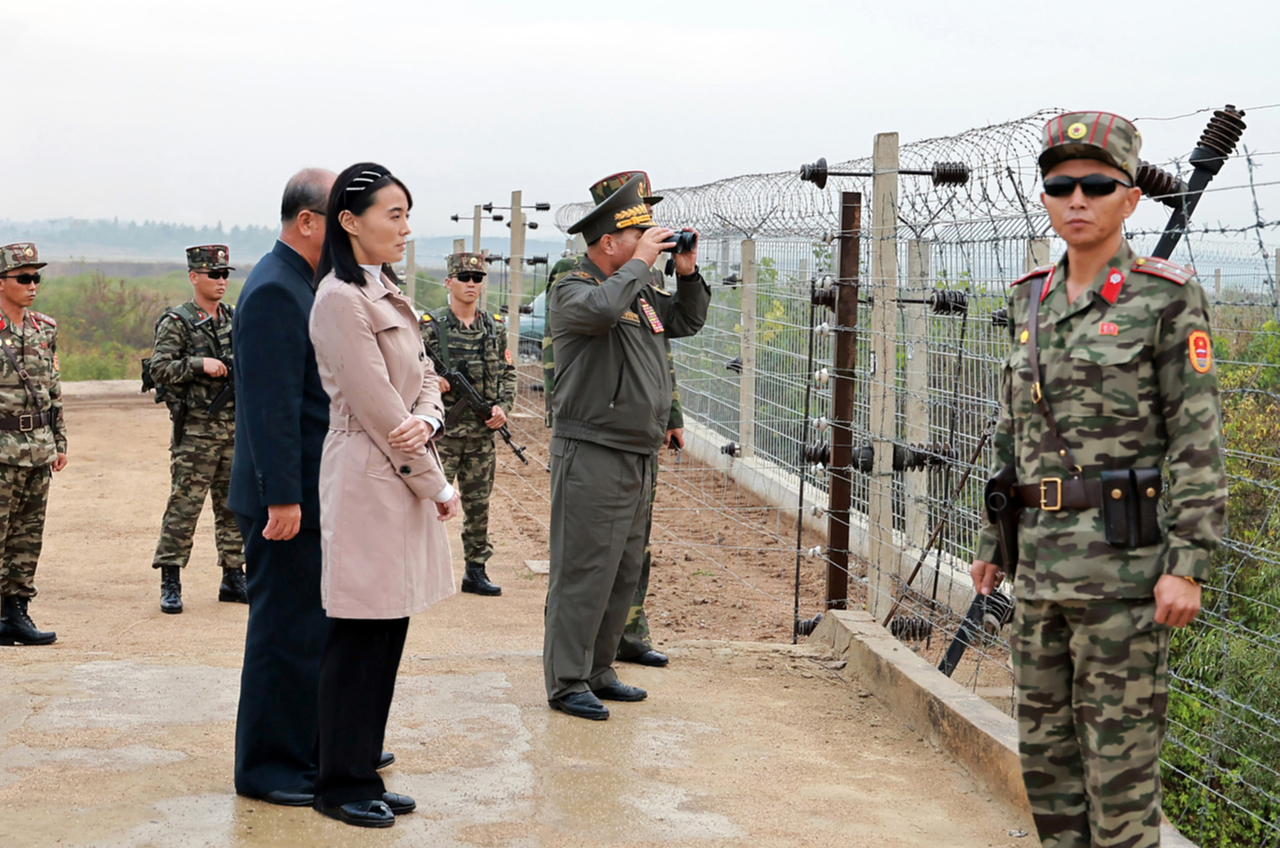
The statement followed her inspection of border fortification work near the Military Demarcation Line early Wednesday, an unusual undertaking for a senior party official whose public role has traditionally centered on political messaging rather than direct oversight of military operations.
Kim Yo-jong also singled out Rep. Kim Byung-joo, the ruling Democratic Party of Korea lawmaker serving as a special presidential adviser for defense policy, who had criticized North Korea's threats and called for an apology over its provocations.
"The special assistant to the defense policy of Chongwadae should not talk incoherently but shut his mouth at once," she said, referring to South Korea's presidential office, Cheong Wa Dae.
The personal attack, coupled with repeated warnings of military countermeasures, suggests that Pyongyang is seeking to raise the political costs of Seoul's continued warning broadcasts and warning shots against North Korean troops crossing the MDL during border fortification work, observers say.
North Korea has been fortifying its southern border since April 2024, laying land mines and erecting fences and barriers as part of its efforts to physically separate itself from South Korea. North Korean troops have repeatedly approached or crossed the Military Demarcation Line during the work, prompting South Korean forces to issue warnings and fire warning shots.
Tensions escalated further after a Sept. 21 land mine explosion in the Demilitarized Zone injured three South Korean soldiers. Seoul and the United Nations Command attributed the blast to North Korean mines planted south of the MDL, an accusation Pyongyang has denied.
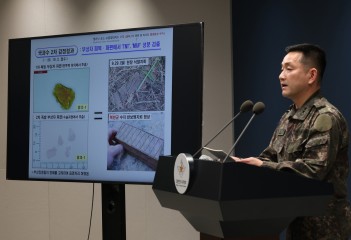
Against this backdrop, Kim Yo-jong's threats appear aimed at deterring further South Korean military responses while reinforcing Pyongyang's claims of territorial sovereignty. However, South Korea's military said Thursday it had detected no signs of new North Korean weapons deployments, suggesting Pyongyang may be using the threat of escalation to pressure Seoul without immediately resorting to military action.
An unusual show of urgency
Kim Yo-jong's direct involvement in the border dispute has also drawn attention to the apparent urgency with which Pyongyang is responding to developments along the MDL.
Hong Min, a senior research fellow at the Korea Institute for National Unification, pointed to her unusual decision on Wednesday evening to personally correct a KCNA report concerning the timing of her border inspection.
Kim Yo-jong clarified that she had visited the area early Wednesday, the same day South Korean forces reportedly fired warning shots at North Korean soldiers in at least two locations.
According to Hong, the correction appeared "intended to establish that her inspection was a swift response to developments on the ground, rather than a previously arranged event."
The unusual intervention in the state news agency's reporting also suggested that North Korea's "propaganda apparatus was operating under considerable time pressure," he assessed.
The apparent urgency has also drawn attention from South Korea's military, with one Joint Chiefs of Staff official, declining to be named, interpreted the unusual correction as a possible sign of Pyongyang's heightened sensitivity to developments along the border.
"The fact that they initially said the visit took place yesterday, only to correct it to today, shows just how nervous they are. They're reacting to the situation," the official said told reporters Wednesday evening.
The episode offers a glimpse into the psychological dimension of Pyongyang's latest campaign: an apparent desire to demonstrate that the leadership is closely monitoring developments along the border and is prepared to respond immediately to what it portrays as violations of its sovereignty.
At the same time, the intensity of the response could suggest that South Korea's continued warning shots are complicating Pyongyang's efforts to establish its preferred interpretation of the border without interference.
Kim Yo-jong's inspection also carried symbolic significance.
During the visit, she explicitly invoked her brother's orders, declaring that the North Korean leader had instructed the military to make the border with the South a permanent boundary and tolerate no concessions over territorial sovereignty.
By presenting herself as the official overseeing the implementation of those instructions, Kim Yo-jong appeared to reinforce both her own authority and the message that Pyongyang's hard-line border policy has the supreme leader's backing.
Why Kim Jong-un remains above the confrontation
Beyond the immediate border dispute, Kim Yo-jong's increasingly prominent role reflects a broader pattern in North Korea's external messaging.
Since September, she has issued a succession of statements on major diplomatic and security issues, including international calls for denuclearization, trilateral military exercises involving South Korea, the United States and Japan, and Seoul's proposed medical equipment assistance to Pyongyang.
She also delivered the political message accompanying North Korea's intermediate-range strategic missile launch exercise on Oct. 3, despite Kim Jong-un having personally observed the drill.
Her brother, meanwhile, has made relatively few direct public interventions in the North's disputes with Seoul and Washington.
Of his 11 publicly reported appearances between Sept. 4 and Oct. 19, only four were related to military affairs, with the remainder largely focused on domestic political events, economic activities and efforts to strengthen internal unity.
Lim Eul-chul, a professor at Kyungnam University's Institute for Far Eastern Studies, said the shift reflects the growing concentration of politically significant external messaging in Kim Yo-jong's hands.
"Previously, messages concerning military activities generally came from the Ministry of National Defense or the General Staff Department, but that has not been the case recently," Lim said.
"This suggests that the responsibility for delivering politically significant policy messages is increasingly concentrated in Kim Yo-jong, while the military functions primarily as an organization responsible for carrying out orders."
Analysts say the arrangement also serves to protect Kim Jong-un's political authority.
In North Korea's highly centralized system, where the supreme leader's pronouncements carry exceptional weight, frequent personal involvement in confrontational exchanges could make it more difficult to justify an abrupt change in policy.
Having his sister deliver the harshest messages allows Pyongyang to maintain an uncompromising posture without necessarily tying the leader himself to every threat or rhetorical escalation.
"The supreme leader does not personally step forward to engage in every exchange of harsh rhetoric," Lim said.
"Kim Yo-jong can be understood as taking the lead in delivering messages toward South Korea and the United States on Kim Jong-un's behalf, while simultaneously protecting his authority."
mkjung@heraldcorp.com